



Introduction
Many of the systems discussed in this article fall under what is commonly called the Internet of Things (IoT): connected devices such as phones, wearables, cameras, appliances, thermostats, and vehicles that collect and transmit data.
These are the smart devices we know and use. The data is typically transmitted via Wi-Fi, Bluetooth, cellular, or other networks.
A closely related term, the Internet of Bodies (IoB), refers specifically to connected devices worn on, implanted in, or closely associated with the human body, such as fitness trackers, smartwatches, and medical devices.
The data collected can be physiological, biometric and even behavioral.
In recent years, a related concept has emerged: the Internet of Behavior (IoB). Unlike IoT, which centers around devices, IoB fixates on what those devices reveal: patterns of movement, timing, interaction, and habit.
These can be analyzed, predicted, and acted upon.
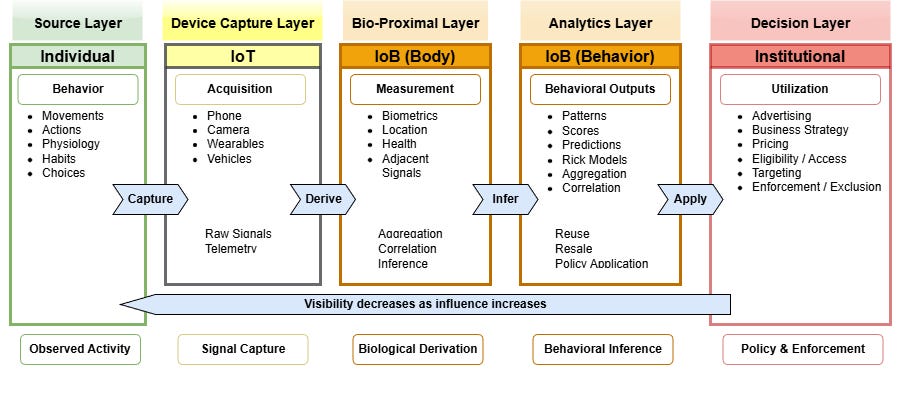
In practice, Internet of Bodies data often feeds directly into Internet of Behavior systems. The shared acronym adds unnecessary confusion.
Many people who buy smart devices may believe they understand technology well enough to manage the risks.
They install their own cameras, configure a smart TV, wear a smartwatch, and adjust privacy settings when prompted. From their perspective, this feels like competence.
The problem is not a lack of intelligence. It is a mismatch between surface-level control and system-level reality.
Manufacturers, engineering teams, and regulatory bodies operate within defined testing and compliance frameworks. Those frameworks do not cover every interaction, edge case, or downstream data use.
Vulnerabilities persist not because teams are careless, but because complexity, time pressure, and commercial incentives guarantee blind spots, particularly around data collection and reuse.
Some vulnerabilities are structural, arising from design tradeoffs, product requirements, or data-driven features that were not designed to function as security controls.
Others are incidental. Manufacturer data logging, backdoors, regression testing lapses, and software or firmware updates introduce exposure even when functioning as designed.
Even hardware has unknown failure modes, especially when built on bleeding-edge components.
Over the past decade, consumer technology has shifted quietly from isolated devices to continuous data producers.
Phones, wearables, vehicles, home appliances, and apps no longer function as standalone tools.
They operate as nodes in large behavioral data pipelines. What they collect is rarely limited to what users assume, and how that data is reused is often opaque.
For years, concerns about pervasive tracking were dismissed as paranoia or conspiracy.
Today, regulators are issuing enforcement actions, banning data practices, and documenting harms that reflect many of those earlier concerns.
The issue is no longer whether data is being harvested. It is how normalized the process has become, and how little visibility users have into what happens after collection.
This post is not about speculation or worst-case fantasies. It is about what already exists, what has already gone wrong, and why the gap between perceived tech literacy and actual system understanding leaves most users exposed.
Control Scenarios: Where This Is Already Happening
These examples are not hypotheticals. They are real, deployed systems that illustrate how behavior is increasingly translated into scores, categories, and consequences.
Driving Behavior and Insurance Pricing
Many drivers now participate in telematics-based auto insurance programs. These systems use phone sensors or vehicle-installed devices to measure acceleration, braking, speed, time of day, and driving frequency.
The stated goal is safer driving. The practical result is behavioral pricing.
Participation is often marketed as optional and beneficial, but the underlying model is important: continuous monitoring produces a risk profile, and that profile directly affects cost.
This establishes a precedent. Once behavioral scoring is normalized in one domain, extending it to others becomes a policy decision rather than a technical challenge.
Wearables, Health Data, and “Incentives”
Smartwatches and fitness trackers increasingly integrate with employer wellness programs and insurance-linked incentive systems. Over the past few years, Medical Internet of Things (MIoT) devices have proliferated significantly. [1]
Activity levels, sleep patterns, and biometric indicators are used to offer discounts, rewards, or program eligibility.
Proponents often frame it as empowerment through personal data ownership. In practice, however, it demonstrates another shift: health-related behavior is quantified outside traditional clinical settings and frequently beyond the reach of strong privacy protections like HIPAA.
Even when participation is voluntary, it creates pressure to conform, share, and normalize continuous biological monitoring.
The distinction between “optional incentive” and “expected participation” erodes quickly once systems become widespread.
The Smartphone as a Behavioral Sensor
The modern smartphone is the most comprehensive tracking device most people own. Location, motion, app usage, search behavior, and purchase activity are continuously logged.
Much of this data is collected not only by the device manufacturer, but by third-party software embedded inside apps.
Recent stats from 2024–2025 point to a range of 40 to 80+ apps per mobile user globally. The higher global figures often include pre-installed/system apps (bloatware).
Many people accumulate apps over time without regularly uninstalling them, leading to “app hoarding”.
Each app could collect multiple categories of data to enable functionality, personalization, analytics, or advertising. In many cases, this data is also shared with third parties such as advertisers, analytics providers, or data brokers.
This data can be routinely shared with advertising and analytics intermediaries, some of whom have been formally sanctioned for selling sensitive information. In many cases, users never directly interact with these entities and cannot meaningfully audit what is collected or where it goes.
The important point is not surveillance in the cinematic sense. It is inference.
Patterns of movement, timing, and interaction reveal habits, routines, and vulnerabilities without needing explicit content.
Pricing Systems and Consumer Suspicion
Recent public attention has focused on digital price tags, algorithmic pricing, and concerns about individualized costs based on behavior or perceived willingness to pay. While solid evidence of person-by-person pricing in physical grocery stores remains limited, the concern is technically and economically plausible.
Dynamic pricing systems already exist online. Behavioral pricing models already exist in insurance and finance. Regulators are now scrutinizing these systems precisely because the technical capability precedes clear rules.
What matters here is not whether the most extreme version is currently deployed, but that the infrastructure and incentives already exist.
Once deployed quietly, such systems are difficult to unwind.
Why This Feels New, but Isn’t
Many of these mechanisms have existed for years. What has changed is visibility. Regulatory actions, data breaches, and investigative reporting have pulled back parts of the curtain. Practices once dismissed as fringe concerns are now being described in enforcement documents and court filings.
This creates a cognitive lag. People who considered themselves reasonably tech-literate are discovering that the systems they trusted operate far beyond the settings screens they interact with.
Engineers, consumers, and policymakers alike are realizing that convenience was purchased with long-term data exposure they never fully evaluated.
The result is not a sudden loss of control, but a gradual one, normalized, abstracted, and easy to ignore until consequences surface.
From IoT to IoB: When Devices Become Behavioral Systems
The Internet of Things was introduced as a convenience layer. Sensors, connectivity, and automation promised efficiency: thermostats that learn preferences, appliances that optimize energy use, vehicles that adapt to driving conditions.
What was understated is that every optimization often requires continuous measurement, and continuous measurement produces behavioral data.
The Internet of Bodies and the Internet of Behavior are not separate infrastructures. They are the natural extension of IoT combined with large-scale analytics and machine learning.
Devices no longer merely report state. They generate telemetry that can be aggregated, correlated, and used to infer habits, routines, and risk profiles.
This marks a structural shift.
Data is no longer collected solely to make devices function.It is collected because behavior itself has economic value.
Once captured, that data faces constant pressure for reuse. Analytics improve targeting. Behavioral signals reduce uncertainty in pricing and risk models.
Over time, data collected for one purpose migrates into others, often without user visibility or meaningful consent.
For most users, this transition is invisible. Interfaces expose settings and permissions, not downstream buyers, inference models, or retention policies. The result is a widening gap between perceived control and actual exposure.
Evidence: Where the System Has Already Broken
This section focuses on documented failures and regulatory findings, not projections.
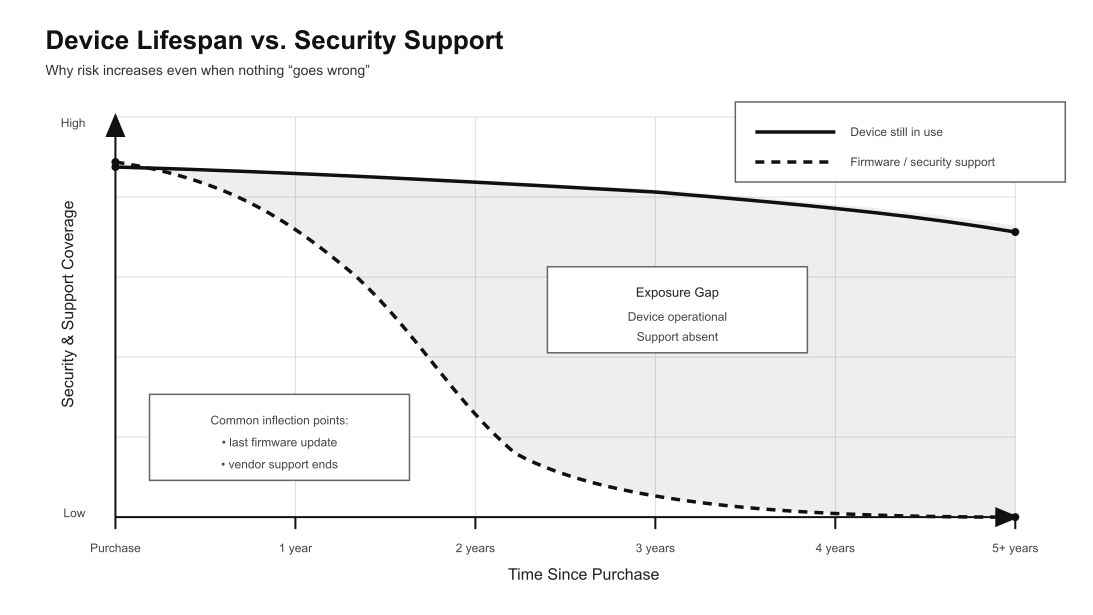
Vulnerability risk increases not because devices fail, but because security support quietly ends while devices remain online.
IoT Compromise Scales by Design
Large-scale IoT compromise is no longer a theoretical risk. It is a solved problem from an attacker’s perspective.
Consumer devices have repeatedly shipped with weak default credentials, limited update mechanisms, and inconsistent post-sale support.
When vulnerabilities appear across millions of identical devices, exploitation scales horizontally.
The Mirai botnet demonstrated this clearly. Ordinary cameras and routers were converted into infrastructure for large-scale attacks simply because basic security assumptions failed at scale. [2]
The lesson is not historical. It is architectural: replication without lifecycle security creates systemic risk.
Surveillance Devices Amplify Harm When Security Fails
Internet-connected cameras, doorbells, and baby monitors concentrate sensitive data by design. When authentication or backend controls fail, the impact is immediate and personal. [3]
Regulatory actions have documented cases where unauthorized access enabled viewing of private spaces and daily routines. In some instances, failures originated with users.
In others, they were rooted in service-provider systems users could not see or influence.
These failures matter because surveillance devices collapse the boundary between digital and physical privacy. Exposure is not abstract. It can enable stalking, coercion, or potential physical harm.
Medical Devices: Cybersecurity as Safety
Connected medical devices make the stakes explicit.
Regulators have required firmware updates for implanted and external medical devices where cybersecurity vulnerabilities could allow unauthorized access or manipulation.
These interventions were not feature enhancements. They were safety corrections.
This illustrates a critical boundary: once digital systems are coupled to the human body, cybersecurity failures could become patient safety failures. [4]
Behavioral Exhaust and Re-Identification
Not all harm requires direct compromise.
Aggregated location and activity data has repeatedly been shown to be re-identifiable, even when stripped of names or account identifiers.
Human mobility patterns are highly distinctive. A small number of data points can uniquely identify individuals with high confidence.
This is not a cryptographic failure. It is an information theory problem.
Behavior itself carries identity.
Data Harvesting: How Behavioral Data Moves
Most users assume a direct relationship: device to manufacturer. In reality, consumer IoT and app ecosystems are multi-party systems.
Devices and apps routinely incorporate third-party software components for analytics, advertising, telemetry, and diagnostics. These components collect usage signals such as location, timing, interaction frequency, and device identifiers. Data may be transmitted to entities the user never directly interacts with.
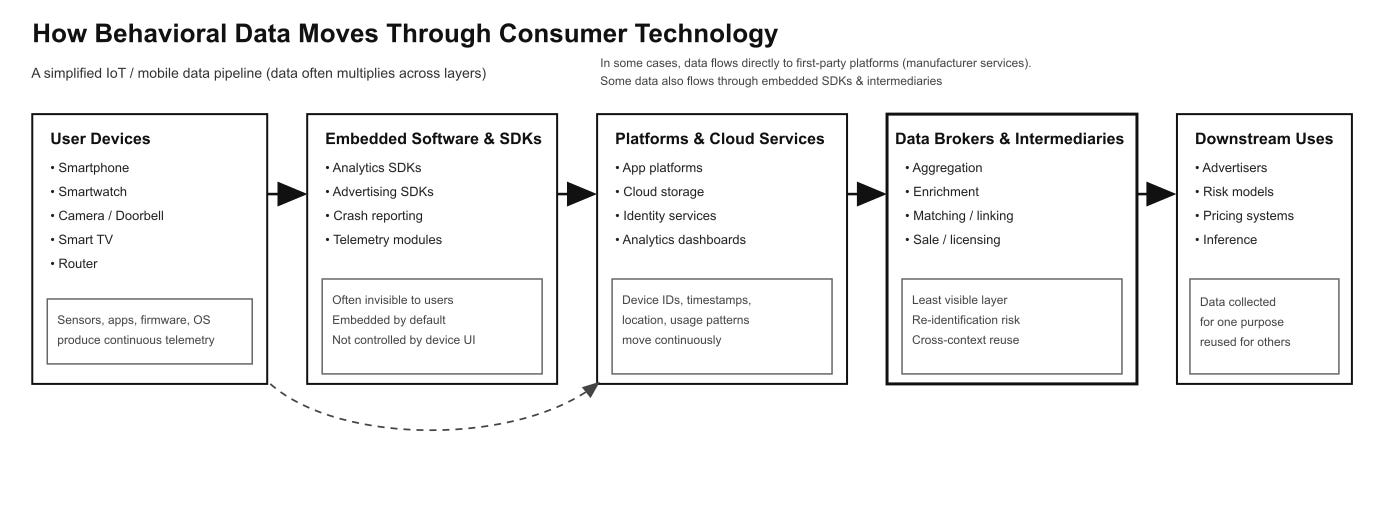
The Federal Trade Commission has documented cases where intermediaries collected and sold precise location, browsing, and health-adjacent data without meaningful consumer awareness.
Some datasets aggregated or sold precise location information that could reveal visits to sensitive places (such as medical facilities, places of worship, or shelters), creating potential risk of discrimination, stigma, or other harms based on exposure of that information. [5][6][7][8]
A common defense is anonymization. However, regulators and researchers have shown that granular behavioral data is frequently re-identifiable when combined across time and sources. [9]
The primary risk is not collection alone, but routine reuse beyond the original context.
Why This Was Dismissed as “Conspiratorial”
Early warnings often lacked documentation or overstated intent. That made them easy to dismiss.
What changed was not public imagination, but evidence availability.
Regulatory enforcement actions, academic work on re-identification, and repeated security failures documented the same mechanisms critics had warned about—this time in official findings and court filings.
The shift from dismissal to concern reflects a delayed recognition of system behavior. The technology did not suddenly become invasive. The documentation finally caught up to deployment.
What Users Can Do: Risk Reduction, Not Elimination
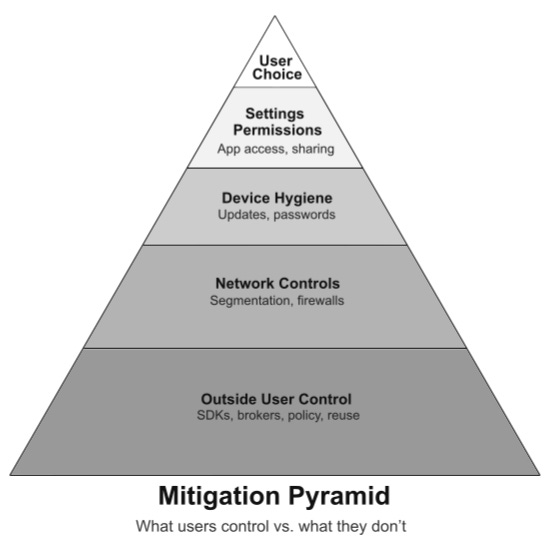
There is no complete opt-out from data collection. There is meaningful mitigation. Note that once your device is connected to the internet, it becomes connected to millions of other computers. Securing your home network is essential.
Keep device firmware and software updated; replace devices that no longer receive updates. Use strong passwords. [10]
Remove default credentials and disable unnecessary remote access features.
Segment IoT devices onto separate networks to reduce blast radius.
Audit app permissions regularly; revoke sensor access that is not essential.
Treat security labels and trust marks as baseline indicators, not assurances of ethical data use or long-term support. [11][12]
These steps do not stop collection. They reduce exposure and limit secondary harm.
Conclusion: Convenience Without Comprehension
Users interact with devices. Institutions interact with behavior models.
Most people did not consent to become behavioral data sources; they consented to convenience. The systems built around that convenience now operate at a scale and opacity that exceeds individual understanding, even among technically capable users.
The problem is not that people ignored warnings or lacked intelligence. It is that the full system was never visible.
This is not a call to reject connected technology. It is a call to recognize that technical literacy at the interface level is no longer sufficient.
The behavioral extraction layer described here operates quietly within everyday consumer systems.
Yet similar and more advanced data architectures scale outward into enterprise analytics, municipal infrastructure, and predictive decision platforms.
Understanding that broader integration requires a separate, deeper examination. One that moves beyond devices and into the systems that act upon aggregated behavior at scale.
Sources were accurate and accessible as of early January 2026, but the web’s a fickle beast. Link rot, site updates, or relocated files might throw a wrench in URLs over time. If a link’s dead, search the title, source, and date, most should still turn up. Citations aim to point you to stable, public spots, but no promises they’ll stay that way forever.
Sources
[1] Haghi M, Thurow K, Stoll R. Wearable Devices in Medical Internet of Things: Scientific Research and Commercially Available Devices. Healthc Inform Res. 2017 Jan;23(1):4-15. doi: 10.4258/hir.2017.23.1.4. Epub 2017 Jan 31. PMID: 28261526; PMCID: PMC5334130.
https://pmc.ncbi.nlm.nih.gov/articles/PMC5334130/
[2] Cybersecurity and Infrastructure Security Agency. “Heightened DDoS Threat Posed by Mirai and Other Botnets.” Revised October 17, 2017.
https://www.cisa.gov/news-events/alerts/2016/10/14/heightened-ddos-threat-posed-mirai-and-other-botnets
[3] Associated Press. “Some Doorbell Cameras Sold on Amazon and Other Online Sites Have Major Security Flaws, Report Says.” February 29, 2024.
https://apnews.com/article/amazon-walmart-temu-doorbell-camera-security-3eededf1b379f894fb7b03b66ecbee72
[4] U.S. Food and Drug Administration. “Cybersecurity.” Digital Health Center of Excellence.
https://www.fda.gov/medical-devices/digital-health-center-excellence/cybersecurity
[5] Federal Trade Commission. “FTC Order Prohibits Data Broker X-Mode Social (Outlogic) from Selling Sensitive Location Data.” 2024.
https://www.ftc.gov/news-events/news/press-releases/2024/01/ftc-order-prohibits-data-broker-x-mode-social-outlogic-selling-sensitive-location-data
[6] Federal Trade Commission. “FTC Finalizes Order Against InMarket Prohibiting It from Selling or Sharing Precise Location Data.” 2024.
https://www.ftc.gov/news-events/news/press-releases/2024/05/ftc-finalizes-order-inmarket-prohibiting-it-selling-or-sharing-precise-location-data
[7] FTC Order Against Avast (Sale of Browsing Data) — FTC
https://www.ftc.gov/news-events/news/press-releases/2024/06/ftc-finalizes-order-avast-banning-it-selling-or-licensing-web-browsing-data-advertising-requiring-it
[8] FTC Enforcement Action Against GoodRx (Health Data Sharing) — FTC
https://www.ftc.gov/news-events/news/press-releases/2023/02/ftc-enforcement-action-bar-goodrx-sharing-consumers-sensitive-health-info-advertising
[9] de Montjoye, Yves-Alexandre, César A. Hidalgo, Michel Verleysen, and Vincent D. Blondel. “Unique in the Crowd: The Privacy Bounds of Human Mobility.” Scientific Reports 3, 1376 (2013).
https://www.nature.com/articles/srep01376
[10] Cybersecurity and Infrastructure Security Agency. “Securing the Internet of Things (IoT).”
https://www.cisa.gov/news-events/news/securing-internet-things-iot
[11] National Institute of Standards and Technology. NISTIR 8259A: Core Cybersecurity Feature Baseline for Securable IoT Devices. 2020.
https://nvlpubs.nist.gov/nistpubs/ir/2020/NIST.IR.8259A.pdf
[12] Federal Communications Commission. “U.S. Cyber Trust Mark.”
https://www.fcc.gov/CyberTrustMark